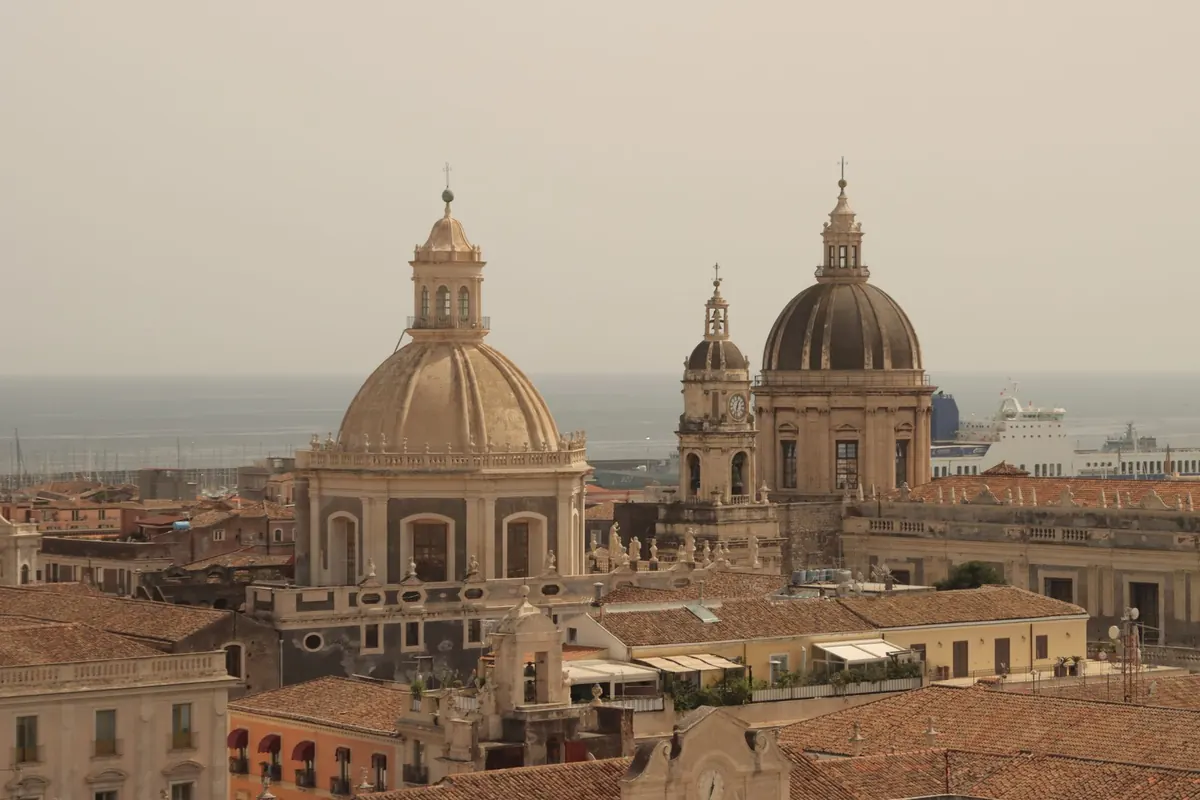
South-eastern Sicily does Baroque at a scale that takes a moment to adjust to. This is not a single cathedral you tick off and drive away from: it is eight entire towns, rebuilt in the same honey-coloured limestone after the 1693 earthquake, close enough together to link by car in five days without spending the whole time behind the wheel. Catania, Militello in Val di Catania, Caltagirone, Noto, Palazzolo Acreide, Ragusa, Modica and Scicli share a UNESCO World Heritage listing, and the southern cluster sits within roughly an hour of itself. Fly into Catania, pick up a small car, and follow the loop below. It runs counter-clockwise and saves the best light for the evenings.
Day 1 – Catania Airport to Noto
Collect the car and get out of the city before you fall in love with it; Catania deserves its own day at the end. Take the E45 south, and if you land before midday, break the drive in Syracuse. Ortigia, the island heart of the city, is a 50-minute run from the airport, and an hour wandering its lanes and eating lunch by the water resets you after a flight. From there it is another 40 minutes or so to Noto.
Noto is the cleanest introduction to the style: an entire town planned on a grid after the earthquake, with a single long corso running gently downhill and every facade the colour of pale honey. Walk it in the late afternoon when the stone turns gold. Start at Porta Reale, follow Corso Vittorio Emanuele past Palazzo Nicolaci — look up at the balconies, where lions, horses and grinning grotesques hold up the corbels — and finish at the cathedral, which partly collapsed in 1996 and has since been rebuilt. If you are here in May, the Infiorata fills Via Nicolaci with flower-petal carpets; book accommodation weeks ahead.
Sleep in Noto, and eat granita with brioche for breakfast the next morning. It is not a cliché, it is a civic duty.
Day 2 – Noto to Ragusa Ibla via Palazzolo Acreide
The drive inland to Palazzolo Acreide takes about half an hour on the SS287, and it is worth the detour for two reasons. First, the town is quiet in a way Noto no longer is, with two fine Baroque churches — San Sebastiano and San Paolo — facing each other across a small square. Second, just above the town, the Greek theatre of Akrai sits in a hollow of almond and olive trees with almost nobody around. It is a good reminder that the Baroque layer sits on top of something much older.
From Palazzolo, allow 45 to 50 minutes to Ragusa. Park below Ibla rather than trying to thread the car through its lanes; the ZTL cameras are not decorative, and the streets were drawn for donkeys. Ragusa Ibla is the most theatrical of the towns, stacked on its own hill with the newer grid of Ragusa Superiore above it. The walk up to the Giardino Ibleo gives you the view back across the rooftops, and the facade of San Giorgio is the one to stand in front of for ten minutes without saying anything.
Dinner: scacce, the folded flatbreads stuffed with tomato, cheese or broccoli, plus a plate of local ragusano cheese. Overnight in Ragusa Ibla or, for lower prices and easier parking, in Ragusa Superiore.
Day 3 – Modica and Scicli
Short hops today, which is the point. Modica is 25 minutes from Ragusa on the SS115, and it is built into two narrow gorges, so everything involves stairs. The Duomo di San Giorgio sits at the top of a long flight of steps, and the church of San Pietro is almost as good. Modica's other claim is chocolate, made in a cold, grainy style that goes back to Sicilian contact with Spain and, further back, with Mesoamerica. Buy a bar of the plain dark, and one with chilli, and see which you prefer.
Carry on to Scicli, another 25 minutes south. It is smaller and easier than Modica, with a single handsome street — Via Mormina Penna — lined with balconies, and Palazzo Beneventano at the end of it, its stone carved with faces that look like they were done by someone enjoying himself. If you have energy left, climb to San Matteo on the hill above town for the view. Scicli and the surrounding countryside appear constantly in the Montalbano television series, so expect a certain amount of location-spotting.
Sleep in Scicli, or base yourself down on the coast at Marina di Ragusa if you would rather end the day with a swim.
Day 4 – Inland to the Mosaics and Caltagirone
This is the longest drive of the trip, roughly two hours to the Villa Romana del Casale near Piazza Armerina, so leave by nine. The villa is a fourth-century Roman country house with the finest mosaic floors in the Roman world, and it deserves a proper two hours rather than a quick circuit. Go early: the corridors get warm and crowded by late morning, and the covered walkways do the mosaics no favours in high season.
From the villa it is about 45 minutes to Caltagirone, which brings you back to Baroque with a difference. This is Sicily's ceramics town, and the whole place is decorated with its own product. The Scala di Santa Maria del Monte, a staircase of 142 steps, is covered in hand-painted maiolica tiles, each step a different pattern. Sit at the bottom with a coffee and watch people drift up and down it in the evening.
Overnight in Caltagirone. Buy something small and breakable, and ask the shop to wrap it properly for the flight.
Day 5 – Caltagirone Back to Catania
Allow about 75 minutes for the drive to Catania, with an optional stop at Militello in Val di Catania, one of the smallest and least visited of the eight towns. In Catania itself, park outside the centre and walk. Via Crociferi is a single street of Baroque churches built in the dark volcanic stone of Etna, which makes a striking change from the honey limestone of the south. Finish at Piazza del Duomo and the fish market behind it, where the noise and the ice and the shouting are the best possible end to the trip.
Where to Sleep, What to Eat, and How to Park
- Bookings: two nights in Noto, two in Ragusa or Scicli, one in Caltagirone is the simplest shape. Guesthouses in the old centres are small, so book well ahead for spring and September.
- ZTL zones: Noto, Ortigia, Ragusa Ibla, Modica and Scicli all restrict traffic in their historic cores. Ask your host where to park before you arrive; most will send a map or meet you.
- Parking lines: white is free, blue is paid (find the meter or a nearby tabacchi), yellow is reserved. Photograph the ticket on your dashboard.
- Car size: a small hatchback. The lanes in Ibla and Modica are not theoretical, and a large SUV will make you unpopular.
- Fuel: choose "fai da te" (self-service) unless you enjoy paying extra for "servito". Many rural stations close on Sunday afternoon.
- Eating hours: lunch roughly 12:30–15:00, dinner from 19:30 or 20:00. Kitchens close early by northern European standards, so don't arrive at 22:00 expecting a full menu.
Practical Notes Before You Set Off
May, June, September and October are the comfortable months; July and August are hot and busy, and August brings Italian holidays to the coast. Pack a hat, refillable water bottle and proper shoes for the stepped towns. Reserve the Villa Romana and any restaurant you have your heart set on a day or two ahead in high season. Carry some cash for small bars and ceramic workshops, and keep a light layer for the evening sea breeze. And drive slowly through the towns: the roads are narrow, the pavements are narrow, and someone will always be reversing out of a doorway that does not look like a garage.
Photo: Efrem Efre / Pexels